

This article describes how the Department of Elections changed a simple, trivial post-election process, and increased the vulnerability of our election systems as measured by one metric to now be 98% of the vote.
While there are many vulnerabilities in our election processes, in my opinion there is one that is the most scary. This is the vulnerability of our systems, to computerized algorithmic cheating. If election systems are open to such an attack, as few as one person could inject improper computer code into the system and control the outcome of elections. While hacking election systems sounds like a remote possibility you can do a google search and be amazed. My favorite headline, 11 year old Hacks into Replica Voting Website in 10 minutes. There are even competitions as indicated here: Hackers Convention
If you want a more detailed understanding of what exactly is algorithmic cheating, want to see an example of how is it done, with a working device, and why our post election audits are really our only protection against such cheating see this article here. The Cheat-O-Matic
The Bad News: The Department of Elections in 2024 made a change to their post election audit processes that made 98% of our vote now more vulnerable to this type of cheating.
The Good News: The solution to eliminate this vulnerability is trivial, simple and in my opinion requires no new laws, or approvals from anyone. They can simply change it back.
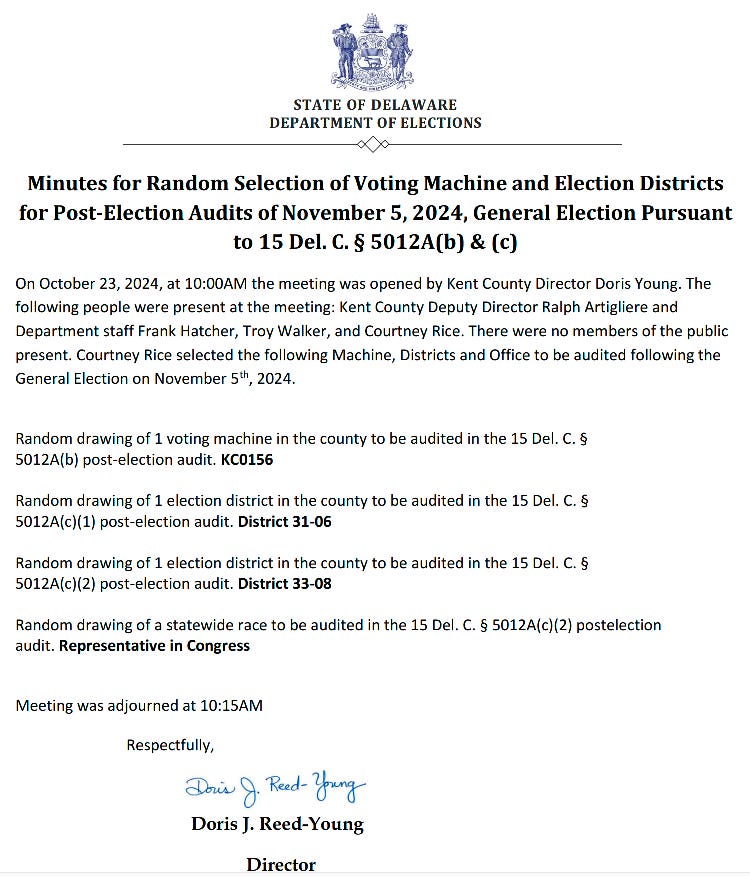
The Process Change: The process change that they made is regarding “when” they perform the “Random Sampling” of the Election Districts. Specifically, the Random Sampling of the Election Districts that they are going to Audit after the election. In all elections prior to 2024, the selection of the districts to be audited was performed after the election as part of the audit. Starting in 2024 they changed that to being a separate step performed BEFORE THE ELECTION in public session.
Here is a copy of the minutes of one such public session performed in 2024. There was one for each county. It takes all of 15 minutes.
I will say this twice in this article.
TELLING BAD ACTORS BEFORE THE ELECTION, WHICH ELECTION DISTRICTS ARE GOING TO BE AUDITED AFTER THE ELECTION, SORTA DEFEATS THE PURPOSE OF THE RANDOM SELECTION AND THE AUDIT ITSELF.
THIS ACTION IS LIKE SAYING: HEY….IF YOU CHEAT, EITHER BY A COMPUTER ALGORITHM, OR BY STUFFING THE BALLOT BOX IN ALL THE ELECTION DISTRICTS EXCEPT THOSE THAT WERE SELECTED TO BE AUDITED YOU PROBABLY WON’T GET CAUGHT.
I would argue that the statement above is obvious to the general public without further elaboration. It should be more obvious to Department of Elections professionals. To them understanding the details associated with audits should be a core competency. With that said, even after being notified of the problem, they continue to perform the selection prior to the election as you can see here.

While this selection has occurred for the 2026 Primary it is still not too late. Again, the process takes all of 15 minutes and could be done after the election, just before the audit just like before.
CALL TO ACTION:
If you are also concerned about the increased vulnerability of our elections as a result of the process change, I would suggest you do your civic duty and write an email directly to the following entities expressing concern and a desire to have the Random Selections changed back to being performed after the election. For ease of email sorting, I might suggest putting: Issue of Concern: Post Election Audits in the subject line. The entities I would suggest notifying.
1. Commissioner of Elections: Anthony.Albence@delaware.gov
2. Board of Elections: StateBoardOfElections@delaware.gov
3. Delaware Elections Task Force: tammy.menard@delaware.gov
In addition, if you choose, I would request you copy me on your email to those entities. My email is dlesher3@comcast.net.
A SPECIAL NOTES TO CANDIDATES: Many talk generically about election integrity. With a simple email you can actually take action on the issue and even perhaps differentiate yourself from your competitors if they don’t.
Additional Context and FOIA Results:
BACKGROUND: During the 2 years prior leading up to the 2024 General Election, myself and others, informed the Department of Elections, that they were not performing the actions required by the Delaware Code, and that as a result our elections were vulnerable to computerized algorithmic attack. There are other vulnerabilities in our systems but this article is focused on computerized algorithmic cheating.
THE FORMER PROBLEM: The issue was the post-election audits. Among other things, the Delaware Code Title 15, requires that the Department of Elections perform a “random selection” of a specified number of Election Districts, and then perform a hand count of all the vote in those election districts. The results of the hand counts would then of course be compared to the results reported by the computers. The problem was, that the Department of Elections was only auditing the “Day of In Person” machines, and was not auditing the Absentee or Early vote for those randomly selected districts. So, any bad actor, or enemy could have targeted that part of our system and it would probably not get caught. The vulnerability in numbers? While it changes election to election in 2022 the Absentee and Early Vote accounted for about 24% of the vote. In 2024 that number increased to just about 50%+/- of the vote.
THE ATTEMPTED SOLUTION: Ultimately, the Department of Elections did decide to try to comply with the the law. In 2024 they incorporated the Absentee Vote, and the Early Vote as part of the post-election audit process. That concept was great, and I applauded that decision as a win in in my article here: A WIN IN DELAWARE
Unfortunately my elation was short lived. When myself and others attended the audits it was discovered that the Department of Elections made a critical change to the audit. This process change was different from all prior audits in prior years. This is when we learned that they had performed the Random Selections prior to the start of voting. Admittedly being redundant for emphasis.
TELLING BAD ACTORS BEFORE THE ELECTION, WHICH ELECTION DISTRICTS ARE GOING TO BE AUDITED AFTER THE ELECTION, SORTA DEFEATS THE PURPOSE OF THE RANDOM SELECTION AND THE AUDIT ITSELF.
THIS ACTION IS LIKE SAYING:HEY….ITS OK TO CHEAT, EITHER BY A COMPUTER ALGORITHM, OR BY STUFFING THE BALLOT BOX IN ALL THE ELECTION DISTRICTS EXCEPT THOSE THAT WERE SELECTED TO BE AUDITED. IF YOU CHEAT ANYWHERE ELSE YOU PROBABLY WON’T GET CAUGHT.
Where does the metric of 98% come from?
If the Random Selections are done before the election, it follows that any bad actors, or state enemy would know what Election Districts are being audited before the elections. What are the rough numbers. In Delaware we audit the complete vote from the random selection of 4 Election Districts of the total, we also sample 1 machine from 4 additional districts and they can’t be from the same districts as the first 4. To make the math trivial let’s round that to about 10 Election Districts. In Delaware we have over 500 election districts. To again make the math trivial let’s round that to 500. That now means that bad actors would know that with this new change, (100% - 10/500) or about 98% of our vote is vulnerable because it will not be subject to audit. Let’s do a simple review:
What would be 0%? According to The Delaware Code, for the Random Sampled districts, all the vote (Absentee, Early, and Day of In Person) vote should be included in the sample, and the Random Selections would be performed after the election are certified. Although the sample is small, the argument is that to some extent this protects, and is a deterrent to cheater on 100% of the vote, and therefore there is 0% vulnerability. Any bad actor would not know where the sample was coming from. Any algorithm applied over all districts in the state would be caught by a proper audit. Note: Bad actors could still play the percentages and cheat in less districts but the math changes. In that case the more they cheat, the more they would have a chance of getting caught.
2022: 24% +/- Vulnerable: According to this type of analysis, the 2022 vote would have been 24% vulnerable. Bad actors, familiar with the actual practice of the DOE would have known that the Absentee and Early Vote was not being audited.
2024 and 2026? 98% Vulnerable: Because the sample was done prior to the election, bad actors would know which districts they shouldn’t cheat. They would also know in which districts they could apply their algorithms and not get caught. As a result, we can see from the calculation above, the number would be 98% +/-.
For a single trivial change we can’t make our elections free from attack, but at least for this metric we could make it go back to 0%. We just need to continue auditing all the vote (Absentee, Early, and Day of In Person) in the sampled districts and simply change the Random Sampling to after certification, and as part of the audit.
HOW DID THIS HAPPEN?: FOIA REQUEST RESULTS:
I found it incredible that such a change could happen. In an effort to learn how this change happened I submitted a Freedom of Information Act (FOIA) request to the Department of elections. I provided background and made specific requests. A copy of the key elements of the FOIA Request is below

I was pleased to find that the FOIA request worked. On 8/21/26 I received the FOIA results. There were more findings other than the topic of this article but I do not want to dilute the subject. I will present what I feel are key observations regarding this topic below.
The Genesis?:
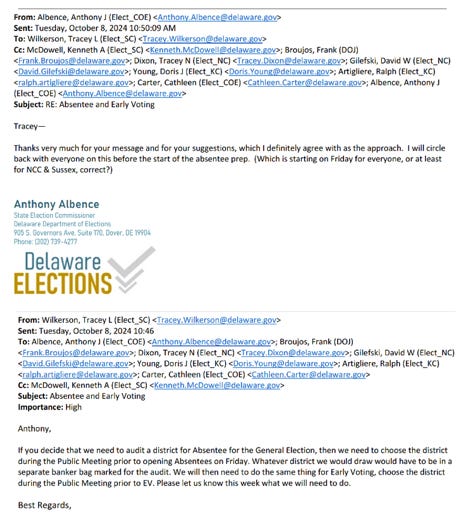
On 10/8/2024 10:46 AM, by email, a suggestion was made regarding the change in procedure. It was from a Deputy Director to the Commissioner. Copied on this email were the Deputy Directors of each county in the state, and a member of the Department of Justice. The email and response that came from the FOIA are here.
Was this stated basis as to why we should do the audit before the election even valid?
For discussion, let’s assume that the first email is the genesis of this change. It is not perfectly clear what the person is talking about. Perhaps the person is thinking about segregating the ballots, or media for those districts from the total, and doing that during normal processing of ballots to save time later and that is why they would need to know the selected ED’s in advance? Here is the problem with this hypothesis. In New Castle County that is not true and such things were not done. As part of normal processing of absentee ballots, they are sorted by Election District prior to opening, then kept that way. No real need for any additional special segregation. With regard to the “Day of In Person” machines only about 1-3 +/- Election Districts are usually processed at a location. No big need to segregate there either. Finally you have the Early Vote ballots. In Early Voting, anyone can vote the ballot for any ED in the County, so the Random ED ballots, must indeed be sorted out of every early vote machine, for every day of early voting, and then they can be counted. In 2024, in a horribly inefficient process the selected Election District’s ballots were sorted after the election not during….so as it turned out they didn’t need the knowledge of which districts were going to be audited for that either. If the stated reason in the email had to do with segregation of the ballots, and none of that was actually done, why did the suggestion regarding doing the Random Selection before the election get implemented anyway? Hmmm?
MOST CONCERNING ISSUE: Let’s leave for the moment whether the basis for recommending the change was valid. The more important observation here is that:
IT APPEARS THAT NOBODY IN THE DEPARTMENT OF ELECTIONS REALIZED THAT THIS WOULD MAKE OUR ELECTIONS MORE VULNERABLE!
RECENT EFFORTS TO GET THE PROCESS CHANGED BACK:
In a recent effort, myself and others sent emails to the Commissioner of Elections and the Board of Elections at the following email addresses respectively: coe_vote@delaware.gov, stateboardofelections@delaware.gov.
I received the following response:
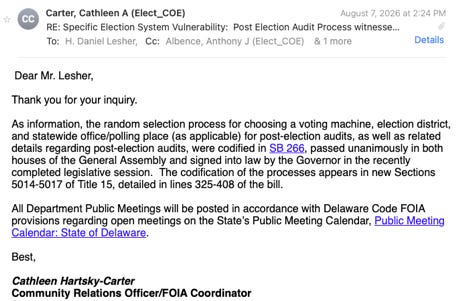
While I am dating myself here, when I got this, it reminded me of a phrase I picked up from watching the movie “All the Presidents Men” where Jason Robards looks at Robert Redford and Dustin Hoffman and says, these are all non-denial, denials.
As you look at the email above, I believe it is technically correct. Yet it does not address the specific question. Where in the code does is say you have to do the Random Selections before the election. I also looked up the section of the code referenced (5014-5017). The code is online and “live” here. Take a look.
https://delcode.delaware.gov/title15/c050/index.html
I’m not perfect but I was not able to find anything in the code that indicated that the random selections are required be done prior to the election. Upon getting this email I again wrote to the commissioner of elections. I also attached the referenced code for convenience and asked if he could show me where it requires that the random selections be performed prior to the election. To my knowledge I have not received a response to date. While it may be of interest, if it is there, it should be clear by now that it was a mistake. I’m curious to to see if anyone after understanding the implication to election integrity, could actually stand up and defend such a change.
SIMPLE, TRIVIAL, SOLUTION : CHANGE IT BACK, NOW!
While the bad news is that the impact of the change is egregious and increases the vulnerability of our elections, the good news again is that the solution is simple. Change It Back!
Believe it or not there may actually be precedence consistent with the DOE being able to change the Random Selections back. In a prior audit, at the beginning of the audit, the DOE personnel announced that there was good news. They had already performed the Random Selections outside of public view and they already had the canisters of ballots that were to be counted, at the front of the room. They actually thought this was a good idea. Upon learning this, the public objected en mass, and after a slight resistance, the DOE personnel said no problem we will do the Random Selections again and continue…..and they did! They didn’t need approval from outside the DOE. They just did it.
In closing, if you agree that the process of the Random Selections should be changed back, please take the actions suggested at the beginning of the article.
Thank you for your consideration.